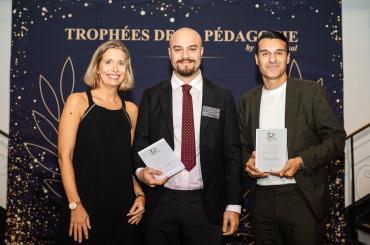


Dr Bilel BENBOUZID

PhD, Affiliated Professor | Affiliated Professor, AI Ethics | | Senior Lecturer in Sociology – UniversitĂ© Paris Est
Image
Dr. Bilel BENBOUZID

Biography

After training as a state-qualified civil engineer, Bilel Benbouzid completed a PhD thesis in the sociology of science on technologies for combating crime.

Following his thesis, he conducted research into predictive policing whilst gradually shifting the focus of his work towards computational social sciences.

He is now more generally interested in issues relating to the regulation of artificial intelligence.

Education & Qualifications

YearUniversityQualification/Position
November 2011 National School of Public Works (ENTPE) and Lyon Institute of Urban Planning. PhD in Geography, Planning and Urbanism. Situational prevention: the origins and development of a practical science.
June 2006 National School of Public Works (ENTPE) Degree in Civil Engineering, combined with a Research Master’s in Planning and Urbanism.

Work experience

YearPosition
2013 – present Senior Lecturer in Sociology, UniversitĂ© Paris Est, Marne-la-VallĂ©e, and researcher at LISIS (Interdisciplinary Laboratory for Science, Innovation and Society)
2014 – present Director of the Master’s 2 programme in ‘Data Science and the Digital Society’ at the University of Paris Est, Marne-la-VallĂ©e

Publications

Journal articles

  • 2019, “Values and Consequences in Predictive Machine Evaluation. A Sociology of Predictive Policing”, Science & Technology Studies, (Forthcoming)
  • 2019, “To predict and to manage. Predictive policing in the United States”, Big Data & Society, No. 6, Vol. 1. [Online]
  • 2018, “When Prediction Means Management: Predictive Policing in the United States”, RĂ©seaux, No. 211, pp. 221–256.
  • 2017, ‘On Crimes and Earthquakes: Predictive Policing between Science, Technology and Divination’, RĂ©seaux, no. 206, pp. 95–123.
  • 2016, ‘Internet Fraud’, RĂ©seaux, No. 197–198, pp. 137–71, (with Sophie Peaucellier)
  • 2016, ‘Towards a Sociology of Online Crime’, RĂ©seaux, no. 197–198, pp. 9–30 (with Daniel Ventre)
  • 2016, ‘Bank fraud in mainland France: victim profiles and decisions to refer cases to the police’, Questions PĂ©nales, XXIX.1
  • 2015, ‘From situational prevention to predictive policing’, Champ pĂ©nal/Penalfield [Online], Vol. XII
  • 2010, ‘Urban planning studies: territories and social uses of urban knowledge’, *GĂ©ocarrefour*, no. 85, Vol. 4, pp. 267–273. (Edited a special issue with Gilles Bentayou).
  • 2010, ‘Urban Planning and Situational Prevention: The Case of the Dispute Among Professionals in Lyon’, MĂ©tropoles [Online], Vol. 8.
  • 2010, ‘The US National Crime Victimisation Survey: from a comprehensive indicator to the analysis of risk factors’, Revue Française de Socio-Ă©conomie, No. 5, pp. 63–82.
  • 2009, ‘Urban planning and its studies: reflections based on two examples of urban development policies in Lyon’, Histoire et Mesure, Vol. XXIV, No. 2, pp. 71–108, (with Gilles Bentayou).

Book chapters

  • 2019, ‘Predictive policing: technology for government management’, in Antoine Courmon and Patrick Le GalĂšs, Governing the Digital City, La vie des idĂ©es, PUF, pp. 67–80
  • 2019, ‘The Legal Regulation of Predictive Policing: Rules, Principles and Calculations’, edited by Gilles Rouet, Algorithms and Public Decision-Making, Les essentiels d’HermĂšs, CNRS Editions, pp. 103–124
  • 2017, ‘Reflexivity in Statistics as Sociology of Quantification: The Case of Repeat Victimisation Modelling’, Sarah Armstrong, Jarrett Blaustein, Alistair Henry, *Reflexivity and Criminal Justice: Intersections of Policy, Practice and Research*, Palgrave, Macmillan, pp. 123–146
  • 2013, ‘The US National Victimisation Survey: From a Comprehensive Indicator to the Analysis of Risk Factors’, in Governing through Science: Comparative Perspectives, Olivier Ihl, Yves Deloye, Alfredo Joignant, Presse universitaire de Grenoble, Libres cours politique, pp. 165–192

Edited journal issues

  • Aykut, S., Benbouzid, B. & Demortain (2019), “Foreknowledge in public policy: new practices, new objects, and new challenges for a political sociology of predictive expertise”, *Science & Technology Studies*, (Forthcoming)
  • Benbouzid, B. & Cardon, D. (eds.), 2018, “Predictive Machines”, RĂ©seaux, no. 211
  • Baya Lafitte & Benbouzid, B. (eds.) (2017), ‘Imagining digital sociology’, Sociologie et SociĂ©tĂ©, no. 160–161.
  • Benbouzid, B. & Ventre, D. (eds.) (2016), ‘Online Crime’, RĂ©seaux, no. 197–198
  • Benbouzid, B., & Benbtayou, G. (eds.) (2010), ‘Urban Studies: Territories and Social Uses of Urban Knowledge’, GĂ©ocarrefours, Vol. 85

Other articles

  • 2016, ‘Who Benefits from Crime?’, La vie des idĂ©es; English version ‘Who Benefits from the Crime?’, 13 September, https://laviedesidees.fr/A-qui-profite-le-crime.html
  • 2015, ‘Rethinking the law in the age of mass surveillance’. Le Monde diplomatique, 3 June 2015, https://blog.mondediplo.net/2015-06-03-Repenser-le-droit-a-l-heure-de-la-surveillance-de.

Reviews (selection)

  • 2016, Alain SUPIOT, *Governance by Numbers*, Paris, Fayard, ‘Weights and Measures of the World’ series, *RĂ©seaux*, no. 195, pp. 229–244.
  • 2014, ‘Quantifying to Transform’, *La Vie des idĂ©es*, 3 October 2014. ISSN: 2105-3030. URL: http://www.laviedesidees.fr/Quantifier-pour-transformer.html
  • 2014, ‘The Governance of Science and Technology’, *La Vie des idĂ©es*, 10 April 2014, URL: http://www.laviedesidees.fr/Le-gouvernement-des-sciences-et.html
  • 2013, Numbers, Ailments and Letters: A Sociology of Judicial Expertise in Economics, Psychiatry and Translation, J. PĂ©lisse, C. Protais, K. Larchet, E. Charrier. Armand Colin, Paris (2012), Sociologie du Travail 01/2013; 55(2):273–275.
  • 2012, ‘Crime statistics’, La Vie des idĂ©es, 12 April 2012, URL: http://www.laviedesidees.fr/Les-chiffres-du-crime.html