Image




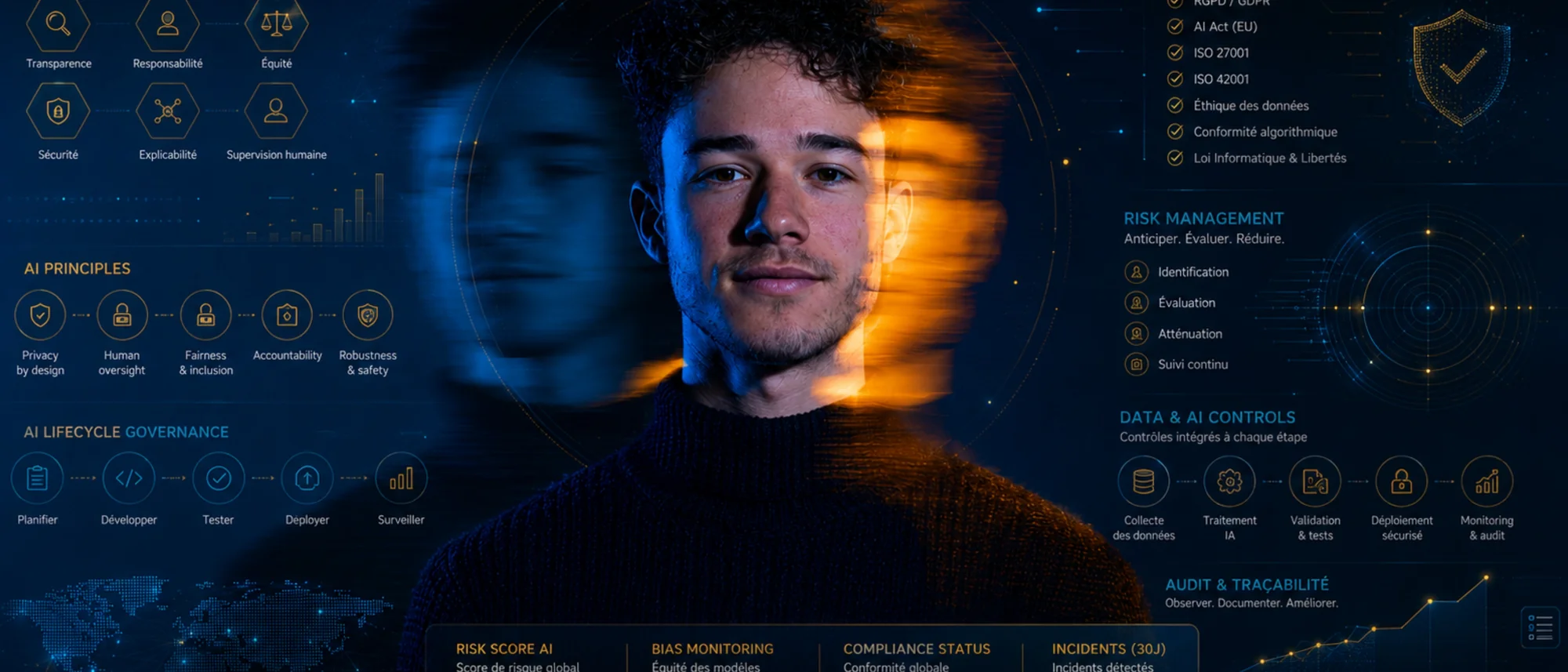
MSc AI Governance, Risk & Compliance
24 seminars, 4 major stages, 6 AI GRC Professional Projects, the Boarding, the Lab, and the AI Clinic.
The Academic Pathway
12 months · 350 hours · 75 ECTS · 24 seminars · 6 AI GRC Professional Projects · 1 RNCP Level 7 block. Each seminar lists its objective, key concepts, and associated project, if applicable.
01
From Technology to Data Governance.
Before regulating, monitoring, or auditing an AI system, one must understand how it is built and what data it relies on. The first seminars provide legal professionals with the technological tools to engage with Data & AI teams and identify risks in practical terms.
Objective: To understand how data flows and how the architecture of an AI system is organized.
Objective: to gain sufficient understanding of how a model works to be able to evaluate its design, performance, and risks.
Objective: To understand new generative architectures and the challenges they pose in terms of privacy, reliability, intellectual property, and accountability.
Objective: To understand what changes when AI no longer merely responds but begins to act.
AI GRC Professional Project #1 — AI Technology & Impact Assessment: Analyze an AI system in terms of its architecture, data, uses, stakeholders, impacts, risks, and liability.
Objective: Apply the data protection framework to the specific characteristics of AI systems.
Objective: Make data governance the first step toward trustworthy AI.
02
From data law to global AI law.
The second step involves translating technological understanding into legal qualifications and operational obligations.
Objective: to integrate issues of sovereignty and vendor dependency into governance decisions.
Objective: To establish data compliance for an AI project, from mapping to remediation.
AI GRC Professional Project #2 — Data Protection & Quality Governance Plan: data mapping, risks, protection, quality, governance, and action plan.
This project contributes to the validation of BC01 for the RNCP Level 7 certification for Project Manager in Artificial Intelligence Solution Development.
Objective: To learn how to determine what constitutes an AI system from a legal perspective and what obligations apply to it.
Objective: To translate regulatory requirements into concrete actions for technical and business teams.
Objective: To legally secure new AI value chains.
Objective: To compare major regulatory models in order to manage technologies, data, and uses deployed across multiple jurisdictions.
03
Building trust beyond mere compliance.
Knowing the law is no longer enough. Professionals must be able to establish governance frameworks, assess risks, address ethical considerations, and demonstrate that systems remain under control.
Objective: to build a comprehensive AI governance framework.
AI GRC Professional Project #3 — AI Governance Framework: registry, responsibilities, policies, controls, oversight, and documentation.
Objective: To identify, assess, prioritize, and address risks associated with AI systems.
Objective: to integrate the ethical boundaries of a system beyond mere compliance.
One question underpins the entire seminar: "Can we do it?" is not the same question as "Should we do it?"
AI GRC Professional Project #4 — AI Risk, Ethics & Trust Assessment: evaluating a system across five dimensions: Legal, Risk, Ethics, Trust, and Human Oversight.
Objective: to move from declared compliance to demonstrated compliance.
AI GRC Professional Project #5 — AI System Audit & Control Report: Conduct a technology-informed GRC audit and develop a remediation plan.
Objective: Learn how to use AI without delegating legal judgment to it.
Objective: Build a specialized assistant capable of leveraging expert legal knowledge.
04
From the legal AI agent to the Augmented AI GRC function.
The final section prepares participants for a world in which AI no longer merely assists legal professionals: it begins to intervene directly in legal and compliance processes.
Objective: to design agents capable of acting within a controlled legal framework.
Objective: to build systems capable of detecting regulatory changes, identifying their impacts, and triggering the appropriate actions.
Objective: To assess not only a supplier's compliance but also the strategic dependence it creates.
Objective: to detect, classify, document, make decisions, remediate, and communicate in response to an AI incident.
Scenario: AI Crisis Room.
Objective: To transition from ad-hoc projects to a fully-fledged AI governance function.
Objective: As AI automates research, analysis, and drafting, create greater value through judgment, interpretation, arbitration, and accountability.
AI GRC Professional Project #6 — Legal AI & GRC Transformation Blueprint: assessment → technology → law → risks → ethics → governance → stakeholders → target organization → roadmap.
Understand → Protect → Qualify → Govern → Evaluate → Audit → Act → Transform. One goal: AI that is compliant, controlled, and trustworthy.
AI GRC Professional Portfolio
Throughout the 24 seminars, each participant gradually builds a portfolio of six professional projects, illustrating their progression from law to operational governance.
Analyze an AI system in terms of its architecture, data, uses, stakeholders, impacts, and risks.
Data mapping, risk assessment, protection, quality, governance, and an action plan for an AI project.
Register, responsibilities, policies, controls, oversight, and documentation of a comprehensive framework.
Assess a system across five dimensions: Legal, Risk, Ethics, Trust, and Human Oversight.
A technology-informed GRC audit accompanied by a remediation plan.
A transformation project built around a real-world challenge: from diagnosis to roadmap.
Technology & Impacts · Data Governance · AI Governance · Risk & Ethics · Audit · Transformation.
Much more than a program
6 professional projects to analyze real-world AI architectures, demonstrate your progression from legal frameworks to governance, build a portfolio of demonstrable achievements for interviews, and prove your ability to integrate Law + Technology + Risk + Ethics + Governance.
Before the seminars begin, a 24-hour tutored online technical program covering: Data, architectures, Machine Learning, Generative AI, LLM, RAG, APIs, and AI agents. No technical prerequisites are required—just an understanding of the language of those you will be governing.
32 hours of guided workshops throughout the year: analyzing an AI architecture, mapping data flows, assessing a system, conducting a risk analysis, building a governance framework, analyzing an agent's audit trail, and prototyping a legal assistant.
Tackle real-world governance challenges even before graduation: AI Governance, Data Governance, risk mapping, compliance, Responsible AI, auditing, sovereignty, and Legal AI. The Clinic has already supported more than 120 organizations with concrete issues.
Here, AI governance isn't just learned from textbooks. It is built, tested, and put to the test in the real world.
The information presented on this page is for informational purposes only and is not contractually binding. Given the rapid evolution of Artificial Intelligence and data, aivancity reserves the right to modify the program content, certifications, terms and conditions, schedule, and fees. The final terms and conditions are those communicated at the time of enrollment.