


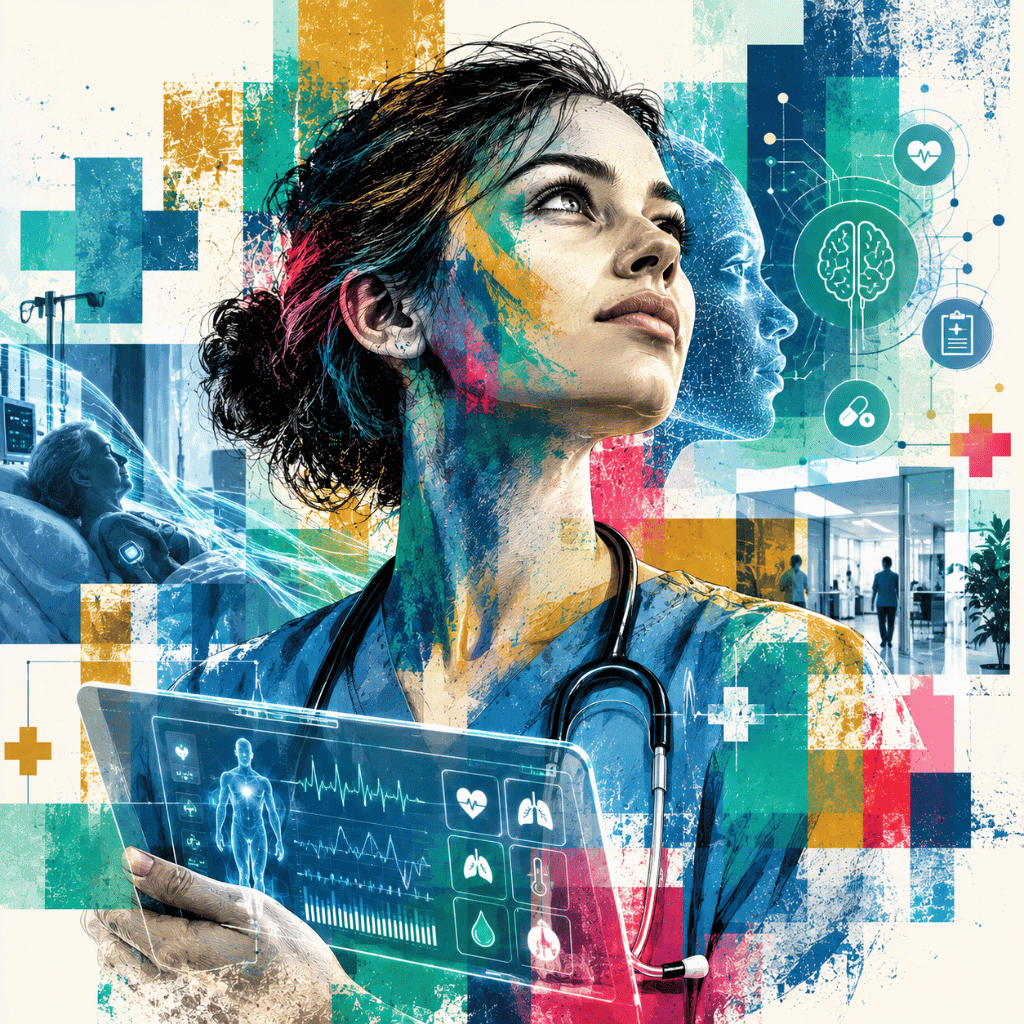
From early warning systems to documentation assistants, artificial intelligence is gradually entering care settings. For nurses, the challenge is not to delegate clinical judgment to an algorithm, but to understand what these tools actually measure, what they can improve and under what conditions their use remains safe, explainable and beneficial to the patient.
From traditional patient monitoring to AI-augmented care
Nursing relies on a combination of clinical, technical, interpersonal and organizational skills. Monitoring health status, administering treatments, delivering care, preventing complications, educating patients and coordinating with other professionals form the core of the practice. Electronic health records, monitors and digital medical devices have been in place for years, but they have not removed the need to observe the patient, put measurements in context and exercise clinical judgment.
Artificial intelligence now adds a layer of analysis to this digital environment. In this article, the term refers in particular to models capable of identifying patterns in clinical data, producing a risk score or, in the case of generative AI, producing text from the information provided. This distinction matters: a predictive system that calculates a risk of deterioration does not work like a generative assistant that summarizes a record, and their levels of evidence, risks and uses are not the same.
One of the best-documented examples involves the early detection of deterioration in hospitalized patients. In 2025, a multicenter pragmatic trial published in Nature Medicine evaluated CONCERN, an early warning system based on machine learning and on patterns drawn from nursing documentation. The study covered 60,893 hospitalizations across 74 clinical units in two health systems. The intervention group showed a 35.6% reduction in the instantaneous risk of death compared with usual care, expressed as an adjusted hazard ratio of 0.64. This result should not be read as an absolute 35.6% drop in mortality: it is a relative measure of instantaneous risk within the specific context of this trial.[1]
The publication was subsequently corrected in April 2026. The authors revised the estimates for length of stay and 30-day readmission following a modeling error, without changing the statistical significance of the affected results or the primary mortality outcome. This correction illustrates an essential rule for evaluating AI systems in healthcare: results must be read in their most recent version, along with their methodological limitations, and not as general proof that the same tool will deliver the same benefit in every hospital.[2]
This transformation is taking place at a time when nurses make up the largest health professional group worldwide. The World Health Organization’s State of the world’s nursing 2025 report estimates the global nursing workforce at 29.8 million in 2023, up from 27.9 million in 2018, while still putting the global shortage at 5.8 million professionals. The same report lists digital technologies among the areas for which the profession must be prepared.[3]
These figures do not mean that AI is a direct answer to staff shortages. A technology can automate a task without solving problems of attractiveness, training, working conditions or the geographic distribution of professionals. The real question is therefore more specific: determining whether certain tools can improve the flow of information, risk detection or documentation without shifting the burden to new verification tasks or degrading the care relationship.




Executive MBA AI & Business
Transformation
The MBA reimagined for the AI era. For experienced executives who want to lead their organization’s transformation. Paris, Nice & Dubai.
How AI is transforming nursing practice
AI does not transform all nursing activities in the same way. Some uses rely on predictive models built into patient records, others on sensors and remote monitoring systems, while generative AI is mainly involved in producing or summarizing text. To understand their impact, one must distinguish what the system actually automates from what remains a matter of clinical interpretation.
Monitoring and early warning
Models can combine several signals, such as vital signs, lab results or documentation elements, to produce a score or an alert. The potential benefit lies in identifying trajectories that do not simply correspond to a single threshold being exceeded. The CONCERN example shows that such a system can be evaluated in a real-world trial, but its results cannot be generalized to all early warning systems.[1]
Prioritizing clinical attention
A risk score can help a team identify patients who need prompt reassessment. It is not, however, a care decision. The professional must check the patient’s condition, look for other signs and interpret the result in light of the clinical context.
Assisted clinical documentation
Large language models can be used to structure, rephrase or summarize notes. A systematic review published in 2025 on the uses of LLMs in nursing identified applications in decision support, patient education, documentation generation and workflow optimization, while highlighting risks related to confidentiality, misleading outputs and ethical concerns. The literature remains heterogeneous and does not justify treating generated documentation as reliable without human validation.[4]
Remote monitoring and follow-up
Connected devices can transmit measurements collected outside the hospital. Algorithms can then flag certain changes. Here again, the clinical value depends on the quality of the sensors, the population being monitored, the frequency of false signals and the organization in place to handle alerts.
Information retrieval and synthesis
Generative assistants can help find information or produce a summary from a patient record. The WHO points out, however, that large multimodal models can produce false, inaccurate, biased or incomplete statements. Integrating them into healthcare therefore requires validation procedures suited to how critical the task is.[5]
What is genuinely new, then, is not that nurses use digital tools. It is that some systems now produce scores, predictions or content that can influence how information is read and prioritized. This algorithmic mediation creates an additional need for verification, explainability and traceability.
A new role for nurses
Integrating AI does not turn nurses into algorithm specialists. It does, however, strengthen several dimensions already present in their work: observing, interpreting, coordinating, alerting and explaining. In a more data-rich environment, professional value shifts less toward the mechanical collection of information than toward putting it in context.
Interpreting without confusing score and diagnosis
A risk score may indicate that a patient warrants closer attention, but it does not necessarily describe the cause of their condition. The nurse must compare the system’s output with the clinical examination, reported symptoms, treatments and medical history.
Overseeing alerts within the workflow
A statistically relevant tool can become counterproductive if it generates too many alerts or fits poorly with the unit’s practices. The professional then helps identify situations where the alert is useful, redundant or misleading.
Ensuring documentation quality
When a generative assistant prepares a handoff or a summary, the nurse remains responsible for checking that the essential elements are present, that nothing has been invented and that the wording does not turn a hypothesis into an established fact.
Taking part in tool evaluation
Their proximity to patients gives nurses on-the-ground knowledge that a purely technical evaluation can hardly replace. Their involvement in the design, testing and auditing of systems is especially important when a tool changes monitoring or documentation. Recent work on ambient scribes in nursing specifically highlights the risks of hallucination, omission and bias when nurses are insufficiently involved in development and oversight.[6]
Preserving the care relationship
A system can process data, but it does not provide physical presence, listening or the explanations given to the patient. The more tools automate certain information tasks, the more important it becomes to protect the time and conditions needed for human interaction.
The nurse’s new role is therefore not that of a mere operator of intelligent systems. It consists of integrating these tools into a clinical practice where decisions remain contextualized, traceable and proportionate to the level of risk.
What skills do nurses need in the age of generative AI?
The fundamentals of the profession remain the priority: clinical observation, pharmacology, monitoring, prevention, communication, coordination and clinical reasoning. AI does not diminish the importance of these skills; it creates new situations in which they must be exercised.
Technical and digital skills
- Understanding what the tool does: nurses must be able to distinguish between a predictive model, a rule-based alert system and a generative model. This distinction makes it possible to understand what the output means and what it does not support.
- Reading performance metrics with caution: sensitivity, specificity, predictive value and false positive rate do not mean the same thing. Average performance can also mask gaps between patient subgroups or between clinical contexts.
- Checking data provenance and quality: an alert can only be interpreted if the data feeding it are reliable. A poorly positioned sensor, missing data or outdated information can affect the system’s output.
- Using generative AI without automating trust: a well-worded answer can still be wrong. Users must verify clinical details, any citations and any information that might be carried over into the patient record.
Clinical, analytical and decision-making skills
- Checking the alert against the patient’s actual condition: pain, confusion, behavioral change, dyspnea or a worrying clinical impression may call for action even if a tool has not triggered an alert.
- Recognizing uncertainty: an algorithmic result may come with a probability, a margin of error or a specific domain of use. Understanding this uncertainty prevents turning an estimate into clinical certainty.
- Knowing when to escalate: when an output is inconsistent or the potential consequences are significant, using AI properly may mean stopping the automation, checking the source and calling on the appropriate professional.
Ethical, legal and organizational skills
- Protecting health data: clinical information is particularly sensitive. Its processing must comply with the applicable framework, including rules on data protection, access rights and system security. Using an external generative service must never lead to patient data being shared without an authorized framework.
- Understanding the AI Act framework without overstating it: in the European Union, certain AI systems associated with regulated products, including medical devices meeting the conditions set out in Article 6 of the regulation, may fall into the high-risk category. As of September 2026, the AI Act is still being phased in: according to the European Commission, the rules for high-risk systems are scheduled to apply from December 2, 2027, and those for AI embedded in certain physical products, including medical devices, from August 2, 2028. These deadlines should be distinguished from obligations that already apply and may still be affected by ongoing legislative developments.[7]
- Taking part in governance: frontline professionals must be able to report errors, document incidents, contribute to audits and take part in decisions to keep, modify or withdraw a tool.
Can artificial intelligence make nursing care more reliable?
The answer depends on what we mean by “reliable.” A system can improve the detection of an event in a given context without improving every dimension of care quality. Reliability must therefore be examined on several levels: accuracy of measurement, predictive performance, quality of integration into the unit and the team’s ability to act correctly on the information produced.
What the evidence supports
The CONCERN trial provides stronger evidence than a mere technical demonstration, because it was conducted in real clinical units and compared teams informed by the system with usual care. The corrected results published in 2026 retain a statistically significant reduction in the instantaneous risk of death, a more modest reduction in length of stay and a lower instantaneous risk of sepsis. The study also observed an increase in the instantaneous risk of unplanned transfer to intensive care, a result that may be consistent with earlier detection but must be interpreted in the context of the protocol.[1][2]
These results do not show that a standalone algorithm “saves lives.” The intervention includes a system integrated into the patient record and the teams’ work, with an organizational chain in place to handle the alert. The observed benefit therefore depends on the combination of technology and organization, not on the model alone.
Limitations to watch
- False positives and alert fatigue: an overly sensitive system can multiply notifications and divert attention. Performance must be assessed against the actual volume of alerts and the unit’s capacity to respond to them.
- False negatives: the absence of an alert does not guarantee the absence of risk. Clinical signs and the caregiver’s experience remain essential.
- Bias and generalization: a model developed in a limited set of facilities or populations may perform worse elsewhere. External validation and post-deployment monitoring are necessary.
- Generative AI hallucinations: in documentation, the main risk is not just a grammatical error but the addition of a fact that was not present, the omission of an important element or the excessive rewording of an uncertainty. The WHO recommends explicit governance of large multimodal models in healthcare and stresses the risks of false, biased or incomplete content.5
- Automation of trust: when a system frequently provides correct answers, users may become less vigilant. Human oversight must therefore be organized as an active step, not as a generic statement added to the protocol.


MSc AI for Business
Steer high-impact strategic AI projects. Seminars every other weekend, compatible with a professional activity. RNCP Level 7 certification.
AI can thus improve certain monitoring and decision-support processes when it is properly evaluated, integrated and supervised. It does not make care infallible. The relevant question is not only “does the model perform well?” but “in which situations, for which patients, with which data and with what organization does this performance actually improve care?”
What will nursing look like tomorrow with AI?
It would be premature to describe a single model of “the nurse of tomorrow.” Uses differ across units, countries, digital infrastructures and regulatory frameworks. Several trajectories are nonetheless plausible based on the tools currently being evaluated.
- More assisted monitoring: alert systems will be able to draw on multiple data sources and flag unusual trajectories. Professionals will remain responsible for confirming clinical relevance and deciding on the appropriate escalation.
- More partially automated documentation: generative assistants and ambient tools can reduce certain data entry steps. However, the systematic review of AI-powered documentation systems concludes that quality and accuracy remain variable enough to require rigorous evaluation before widespread adoption.8
- Monitoring more distributed between hospital and home: remote monitoring can shift part of patient monitoring to the home. This requires defining who receives alerts, within what time frames, under which protocols and with what responsibilities.
- Greater involvement in digital projects: nurses could be more involved in choosing tools, designing interfaces, defining relevant alerts and assessing their impact on actual work.
- A stronger requirement for AI literacy: the AI Act already introduces AI literacy provisions that have applied since February 2025. Beyond the law, practical command of limitations, biases and verification methods will become a component of quality use.7
A less visible effect will also need to be monitored: the impact of automation on learning the profession. If certain data collection, writing or triage tasks are gradually handled by systems, organizations will need to ensure that professionals in training continue to acquire the skills needed to understand where information comes from and to detect inconsistencies.
The future of the profession will therefore depend less on a replacement scenario than on how healthcare facilities divide responsibilities between professionals and systems. The more directly a task affects patient safety, the stronger the requirements for evaluation, traceability and oversight must be.
AI-augmented care, at the heart of an ever-human relationship
Artificial intelligence can analyze signals, produce a score or prepare a summary. It does not share the nurse’s professional responsibility and does not experience the situation the patient is living through. This difference is not a philosophical detail: it determines how systems should be integrated into care.
A useful tool is one whose purpose is clear, whose performance is evaluated in a relevant context, whose errors can be detected and whose use undermines neither clinical vigilance nor patient autonomy. For several years, the WHO has stressed the need to place ethics, human rights, transparency and accountability at the heart of AI governance in healthcare.[9]
For nurses, the most significant transformation may therefore be less spectacular than the full automation of care. It lies in the ability to work with more information while maintaining a clear hierarchy between data, alert, interpretation and decision. The system can flag. The professional must still observe, contextualize, explain and act.
Technology can make certain information visible earlier. It can also create new blind spots. The challenge of augmented care is therefore not to choose between artificial intelligence and nursing expertise, but to organize how they work together so that technology genuinely strengthens safety, continuity and the quality of the care relationship.
The question to watch now is this: will healthcare facilities use AI primarily to speed up workflows, or to give professionals back the conditions they need for more attentive monitoring and a more available presence at the patient’s side?
Further reading
To take this reflection on AI in healthcare, human oversight and evolving skills further, here are four complementary reads from the aivancity blog.
Sources
[1] Rossetti, S. C., Dykes, P. C., Knaplund, C., et al. (2025). Real-time surveillance system for patient deterioration: a pragmatic cluster-randomized controlled trial. Nature Medicine, 31, 1895-1902. View the study
[2] Rossetti, S. C., Dykes, P. C., Knaplund, C., et al. (2026). Author Correction: Real-time surveillance system for patient deterioration: a pragmatic cluster-randomized controlled trial. Nature Medicine, 32, 1556. View the correction
[3] World Health Organization. (2025). State of the World’s Nursing Report 2025. View the report
[4] Song, J., Liu, W., Wang, Y., Hu, X., Chen, L., Wu, X., Zheng, C., & Gu, Q. (2025). Application and Challenges of Large Language Models in Clinical Nursing: A Systematic Review. Computers, Informatics, Nursing, 43(9), e01328. View the study
[5] World Health Organization. (2025). Ethics and Governance of Artificial Intelligence for Health: Guidance on Large Multi-Modal Models. View the report
[6] Topaz, M. (2025). Invisible Scribes: Can Nurses Trust Ambient AI for Clinical Documentation? Journal of Continuing Education in Nursing, 56(9), 358-359. View the article
[7] European Commission. (2026). Navigating the AI Act. View on the European Commission website • European Union. Regulation (EU) 2024/1689, Article 6. View the regulation
[8] Bracken, A., Reilly, C., Feeley, A., Sheehan, E., Merghani, K., & Feeley, I. (2025). Artificial Intelligence (AI)-Powered Documentation Systems in Healthcare: A Systematic Review. Journal of Medical Systems, 49(1), 28. View the study
[9] World Health Organization. (2021). Ethics and Governance of Artificial Intelligence for Health. View the report